
Blog Posts
Santorini in the Off Season: The Island After the Summer Crowds Leave
Nov
By November, the final cruise ships have departed, the last seasonal charter flights have wrapped up, and Santorini sheds its summer identity. For seven months of the year, the island operates as a high-volume hospitality machine. When the summer season closes, that machine powers down, revealing a working Greek island inhabited by roughly 15,000 year-round residents.
Traveling to Santorini between November and March requires adjusting your expectations. If you arrive expecting infinity pools, beach clubs, and bustling sunset terraces, you will be disappointed. However, if your priority is geology, archaeology, wine, and unobstructed caldera views, the off season offers an entirely different, even better experience.
What Actually Closes and What Stays Open
A common misconception is that Santorini shuts down completely once autumn ends. Because the island maintains a permanent population, essential infrastructure never closes, though the geography of what remains open shifts dramatically.
- The Beach Settlements Close: Coastal resort towns like Kamari, Perissa, and Perivolos effectively go into hibernation. Beachfront bars, sunbed operators, and seasonal hotels board up until spring, and catamaran cruises around the caldera largely halt due to unpredictable sea conditions. You an still visit the beach of course, and there are a few bars/restaurants and cruises that remain open throughout the season, so you will not be left alone in the middle of nowhere trying to find a snack or bottle of water!
- Basic needs are always met: Supermarkets, bakeries, pharmacies, banks, the local health center, and several year-round restaurants stay open to serve residents.
- Popular villages like Oia and Imerovigli Quiet Down: You can walk the traditional pathways of Oia and Imerovigli year-round, and you will have the famous blue-domed viewpoints largely to yourself. And while the vast majority of luxury cave hotels and cliffside fine-dining restaurants in these villages close for winter maintenance and renovations, you will always find options of open accommodations if you are looking for your own piece of quiet paradise.
Realistic Off-Season Weather
Santorini’s winter climate is mild by northern European standards, yet cool and damp by Mediterranean holiday standards.
In November, daytime highs average around 17°C to 19°C (63°F to 66°F), with evening lows dropping to 14°C (57°F). By December, daytime temperatures settle into the low to mid teens Celsius, averaging around 13.5°C to 15.5°C (56°F to 60°F). Rain becomes more frequent from November through February, accompanied by brisk Aegean winds. While sea temperatures in early November hover near 20°C (68°F), swimming is generally off the table for the rest of the winter. Packing layers, a windproof jacket, and sturdy walking shoes is essential.
Best Things to Do in Santorini Without the Crowds
With the summer heat gone, outdoor exploration and cultural sites become the centerpiece of a Santorini itinerary.
1. Walk the Fira to Oia Caldera Trail
The 10-kilometer (6.2-mile) footpath connecting Fira to Oia passes through Firostefani and Imerovigli along the edge of the volcanic crater. In July and August, intense sun and bottlenecks on narrow stairs make this a grueling walk. In the off season, cooler temperatures turn the three-hour trek into a comfortable, scenic hike, complete with an optional detour up to Skaros Rock.
2. Explore Ancient Akrotiri and Prehistoric Thira
The Bronze Age Minoan settlement of Akrotiri, preserved under volcanic ash from the 17th-century BC eruption, is housed beneath a bioclimatic roof, making it an ideal rainy-day activity. Pair your visit with the Museum of Prehistoric Thira in Fira to see the original wall paintings and artifacts recovered from the site. Note that Greek archaeological sites switch to winter hours starting November 1, typically operating from 8:30 AM to 3:30 PM and closing on Tuesdays.
3. Taste Volcanic Wines at Year-Round Estates
Santorini’s indigenous Assyrtiko grapes grow in basket-shaped vines woven close to the volcanic soil to shield them from high winds. While harvest season is long over, major estates such as Santo Wines in Pyrgos and the underground Koutsoyannopoulos Wine Museum remain open during the winter months, alongside smaller boutique wineries operating by appointment.
4. Wander the Inland Medieval Villages
To experience authentic island life, head inland to Pyrgos, Megalochori, Finikia, and Emporio. Built away from the cliffs to protect against pirate raids, these settlements feature labyrinthine alleys, Venetian castle ruins, and local tavernas that stay open year-round because their primary clientele lives on the island.
Practical Tips for Off-Season Logistics
Transportation
Local KTEL buses run on reduced winter timetables, while taxis and transfer mini vans are largely available. For maximum flexibility – if narrow streets and steep roads for stress you out, rent a car
Flights & Ferries
Direct international flights mostly stop, but the connection to Athens is always frequent and much cheaper than in the summer. Ferries run art least once per day, for fewer destinations. Connect via Athens (ATH) by plane or take a conventional ferry from Piraeus.
Dining & Hours
There are many open restaurants and tavernas in the winter – however, online opening hours on maps are frequently inaccurate during winter. Call restaurants and wineries ahead of time to confirm winter schedules.
Visiting Santorini after the summer season closes trades convenience and beach weather for stillness, lower accommodation rates, and genuine local hospitality. As long as you plan around winter schedules and base yourself near active villages, the island’s volcanic drama is arguably at its most impressive!
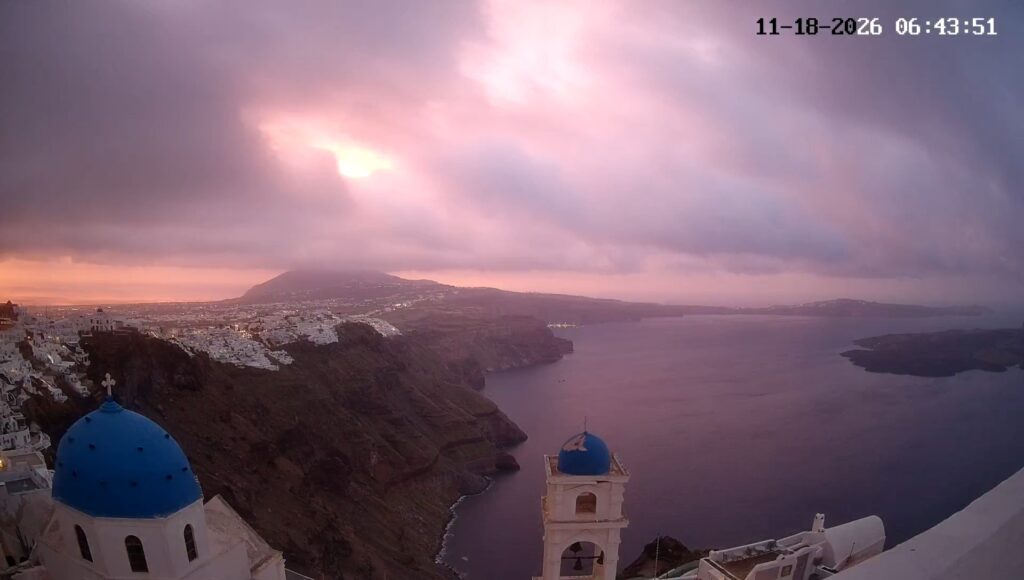
Enjoy live the view of the caldera as well as past timelapses!
This location of the live camera enjoys on the one side a panoramic view of the world-famous volcanic caldera, including views of the Fira and Firostefani cliffside, the Nea Kammeni (volcano), Imerovigli’s blue dome church and many surroundings, and on the other side views of the volcanic islands, and those legendary, unedited Santorini sunsets! From these vantage points, viewers can enjoy a sweeping, uninterrupted perspective that captures the dramatic scale of the cliffs. You may find it here.