
Blog Posts
Thera, Thira or Fira?
Apr
Is it Thira or Fira?
And what about Thera?
It happens every summer: a traveller looks at their ticket, and wonders, “Wait, am I going to the correct destination?”
Don’t worry. You aren’t lost, and the locals aren’t playing a prank on you. Thira and Fira do sound almost the same, and nothing like Santorini. The naming convention of this volcanic paradise is just a bit… layered. Here is the definitive guide to unmasking the island’s name.
1. Santorini
Yes, our island. Most people call the island Santorini, but that isn’t its original name. The name of Santorini island has changed a lot since it’s beginning, from Strogyli (the round one), to Kallisti (the beautiful one) to Thira. In the 13th century, Latin Empire crusaders named it after Saint Irene (Santa Irini).
Today, “Santorini” is the brand name. It’s what you see on postcards, airline websites, and luxury perfume ads. If you tell your friends you’re going to Santorini, they’ll know exactly which blue domes you’re talking about.

2. Thira and Thera
Thira, is the official name of Santorini. You will find it as the destination on your ferry and airplane tickets, government documents, and on any map of Greece that is large enough to include this small island of the Cyclades.
Thera on the other hand, is the official name given classically, before simplifications. If you ask me, for a non-Greek-speaking reader, Thera is the correct way to write it, as the letter i in English sounds a lot different than the ί in Greek. In any case, the name is pronounced THEER-ah ([ˈθira] in Greek).
The name Thira comes from the Spartan ruler King Thiras, who colonised the island then named Kallisti and renamed it.
3. Fira
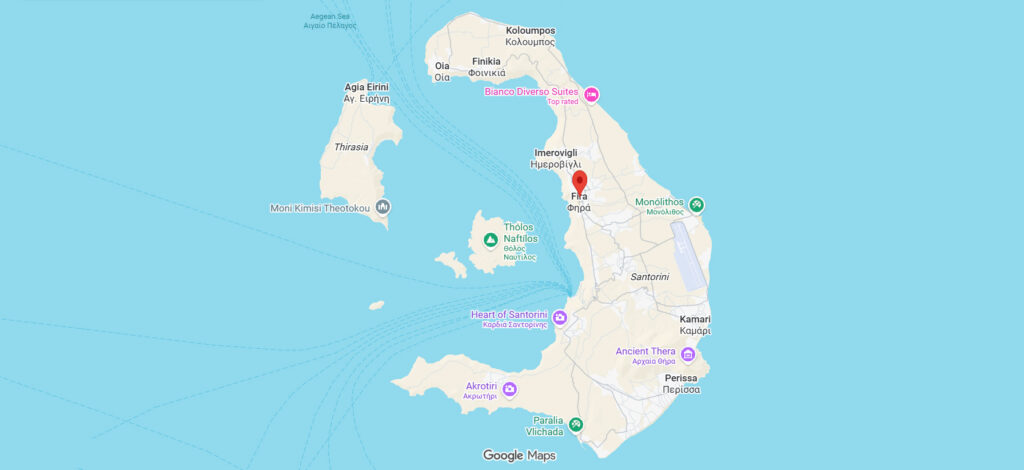
While most Greek islands give their official name to also the capital of the island, Santorini’s main town is called Fira. Now, here is where the confusion usually peaks. Fira (pronounced Fee-rah) is very similar sounding to Thira (Thee-rah). We don’t really know where the name Fira originates from, but it is not harmful to assume that over the many years since the 800s BCE the name Fira was just a mispronunciation, or misinterpretation of Thira. That being said, in Greek they are two names also have different punctuation, as it is ThEE-rah and Fee-rAH, so we leave it to the reader to decide on the origin of the name Fira.
Because “Fira” sounds so much like “Thira,” people often use them interchangeably. Don’t. Or do, it is so common for travellers that locals will just know what you mean.
Thira = The whole 76 square meters island.
Fira = The specific town where you buy your souvenirs and gyros.
On a similar note, here some pronounciation information on Oia Village
In Greek, the letters “o” and “i” combined bring the sound “ee”. The correct pronunciation therefore is Ee-ah, not O-e-ah as most visitors call it. Again, if you don’t mind being corrected by willing to assist locals, use whichever comes naturally, you will end up in the right village anyway.
A Note on “Old Thira”
Just to make things a little more spicy, there is also Ancient Thira. This is an archaeological site located on a mountain between the beaches of Kamari and Perissa. It’s a stunning spot to visit, but if you tell a taxi driver “Take me to Thira” when you actually want to go to the ancient ruins, you might end up at the post office in the capital instead! Ancient Thira archaeological site is also different than the ancient city of Akrotiri. You can read more about Ancient Thira and Akrotiri excavations here.
We hope the differences are now as the Aegean water!